
Personal branding is often framed as a marketing exercise.
But when viewed through the lens of communication strategy, it becomes something else entirely.
Strategic communicators approach professional positioning the same way they approach any complex communication challenge.
With curiosity.
Audience Identification
Every communication strategy begins with a simple set of questions:
Who are we speaking to?
What do they need to understand?
Why should they care?
When working with professionals on their personal brand, the same framework applies.
The key question often becomes:
Who cares?
Why should your audience care about your work?
What problems are they trying to solve?
What prevents them from recognising the value you bring?
Clarity here changes everything that follows.
Narrative Positioning
Once those questions are answered, the structure of your communication becomes far clearer.
Strong positioning rarely begins with credentials.
It begins with relevance.
The most effective narratives lead with why the audience should listen, not with a list of achievements.
When your message begins with the audience’s problem, it creates narrative tension.
That tension is what holds attention.
Communication Intent
Another useful tool strategic communicators rely on is a deceptively simple question:
“So what?”
Not once.
Not twice.
But often three times.
The first answer is usually surface level.
The second answer gets closer to the real insight.
By the third time the question is asked, the positioning of the message often changes entirely.
What began as information becomes perspective.
And perspective is what creates authority.
Strategy Before Visibility
When professionals approach personal branding through strategic thinking, communication becomes far more deliberate.
Instead of asking:
“What should I post?”
The question becomes:
“What do I want to be known for?”
That shift moves personal branding out of the world of performance and into the world of strategy.
And when strategy leads communication, credibility follows naturally.
Your career evolved.
Your language didn’t.
If your LinkedIn and professional narrative no longer reflect the level you’re operating at, you’re likely being overlooked for the opportunities you’re ready for.
At a certain point in your career, something subtle shifts.
The work you do becomes more strategic.
Your thinking deepens.
The direction you want to move in becomes clearer.
But the way you describe your work doesn’t keep pace.
Your LinkedIn feels slightly off.
You hesitate when updating your profile.
Posting feels uncomfortable — even though you have something to say.
Not because you lack expertise.
Because your positioning hasn’t caught up yet.
This is the gap most professionals don’t know how to close.
Is this you?
Uncertain strategy: You know personal branding matters, but it keeps falling to the bottom of the list
External visibility: You’re respected internally but barely visible externally
Digital presence: You’ve rewritten your LinkedIn profile countless times, or you ignore it completely
Content strategy: You default to resharing company content because you don’t know what to post
Competitive landscape: You see people with less experience building visibility faster than you
Standing out: You’re in the job market but you’re not landing interviews for jobs that you know you’re qualified for
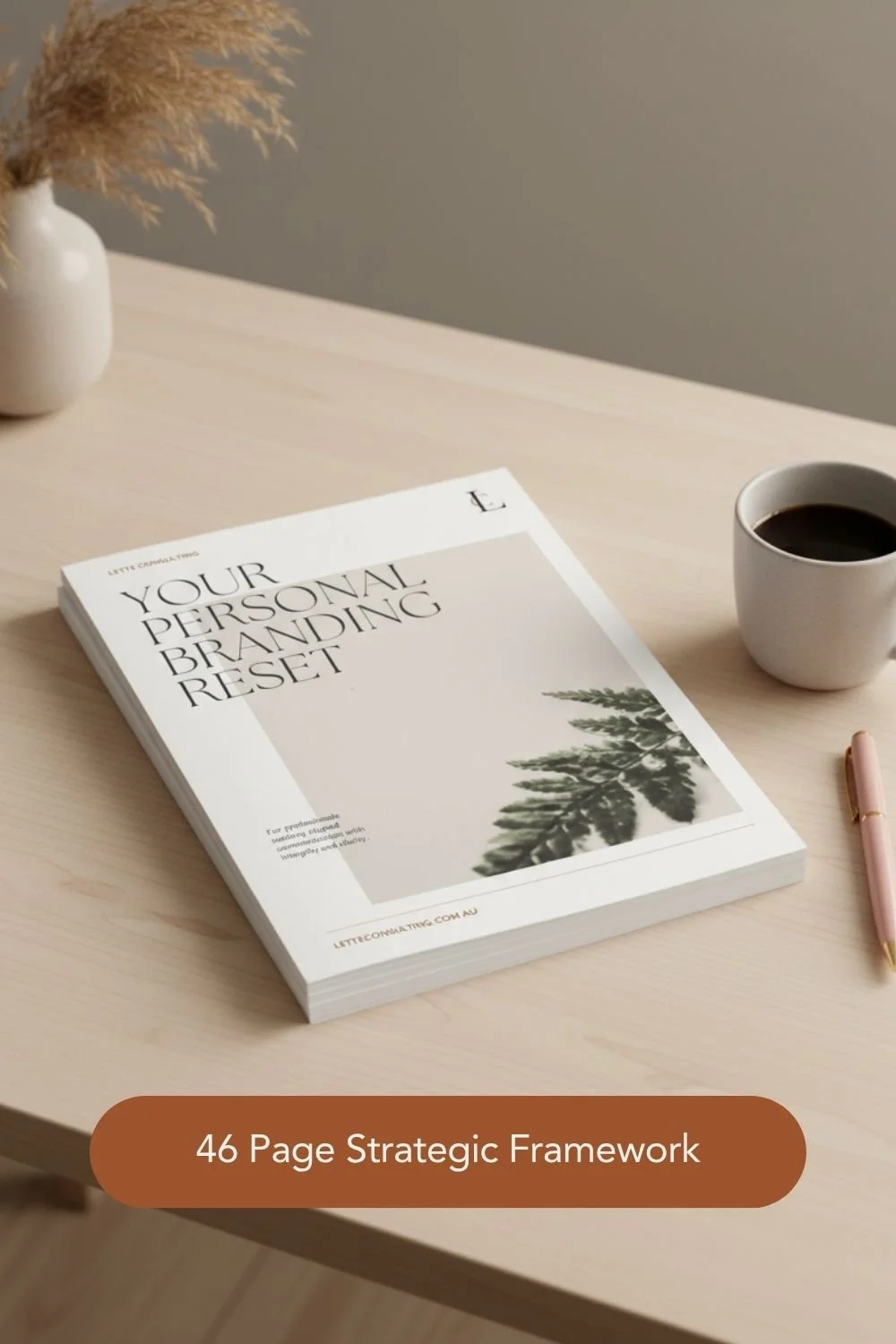
The Personal Branding Reset is a 46-page strategic framework designed to help you:
Reposition your expertise
Articulate your value clearly
Align your communication with where your career is going
Inside Your Personal Branding Reset:
Identity audit → clarify how you’re currently perceived
Articulation frameworks → translate expertise into positioning
Practical prompts → so you’re never staring at a blank page again
Your competence deserves better language.

For many professionals, LinkedIn starts as a digital version of their resume. Early in a career, that makes sense. But careers evolve.