
Why Your LinkedIn Profile No Longer Reflects Your Career Objectives
For many professionals, LinkedIn starts as a digital version of their resume.
Early in a career, that makes sense. The platform functions primarily as a way to demonstrate experience, outline responsibilities, and signal competence to potential employers.
But careers evolve.
And for many professionals — particularly those who provide services — the purpose of LinkedIn evolves with it.
What was once a tool for securing employment becomes something different: a platform for connection, reputation, and opportunity.
Yet many profiles never make that transition.
Which is why, for many experienced professionals, LinkedIn begins to feel slightly off.
When Your Career Evolves Faster Than Your Profile
One of the most common patterns I see is this:
A professional’s career evolves, but their language stays anchored in an earlier version of their expertise.
The profile that once helped them secure roles is still written like a resume, listing responsibilities, titles, and career milestones.
But the work they want now is different.
They are no longer trying to be hired.
They are trying to:
attract aligned clients
build professional reputation
create opportunities for collaboration
position themselves as trusted experts
Those objectives require different language.
Resume Language vs Positioning Language
Resume language explains what you’ve done.
Positioning language explains what you are known for.
This distinction is subtle but powerful.
A resume might say:
Senior Associate specialising in commercial litigation.
Positioning language might say:
Helping organisations navigate high-stakes legal disputes with clarity and strategic communication.
Both statements may be true.
But one communicates responsibilities.
The other communicates expertise and value.
LinkedIn works far better when your profile reflects the second.
LinkedIn Is Not Just a Profile — It’s a Search Result
Another important reality is that LinkedIn is not simply a social platform.
It is one of the most powerful professional search engines on the internet.
If someone searches your name online, your LinkedIn profile will often appear at or near the top of the results.
That means your profile is frequently the first professional impression someone encounters.
Which raises an important question:
What story does your profile tell about the work you do today?
If the answer is unclear — or anchored in an earlier stage of your career — it may not represent you as accurately as you intend.
A Strategy That Evolves With You
One of the most controversial views I held in corporate communications roles was this:
Not everyone needs a LinkedIn profile.
If a profile simply repeats corporate marketing language, follows generic templates, and receives little thought or attention, it does little to strengthen professional reputation.
But if a profile is visible, it deserves strategy.
A clear understanding of:
who your audience is
how your expertise creates value
how you want your work to be understood
And that strategy should evolve as your career evolves.
The Subtle Reset
For many professionals, fixing LinkedIn does not require a dramatic rebrand.
Often it simply requires a reset in how they describe their work.
A shift from responsibilities to expertise.
From job titles to positioning.
From resume language to professional narrative.
A Structured Way to Begin
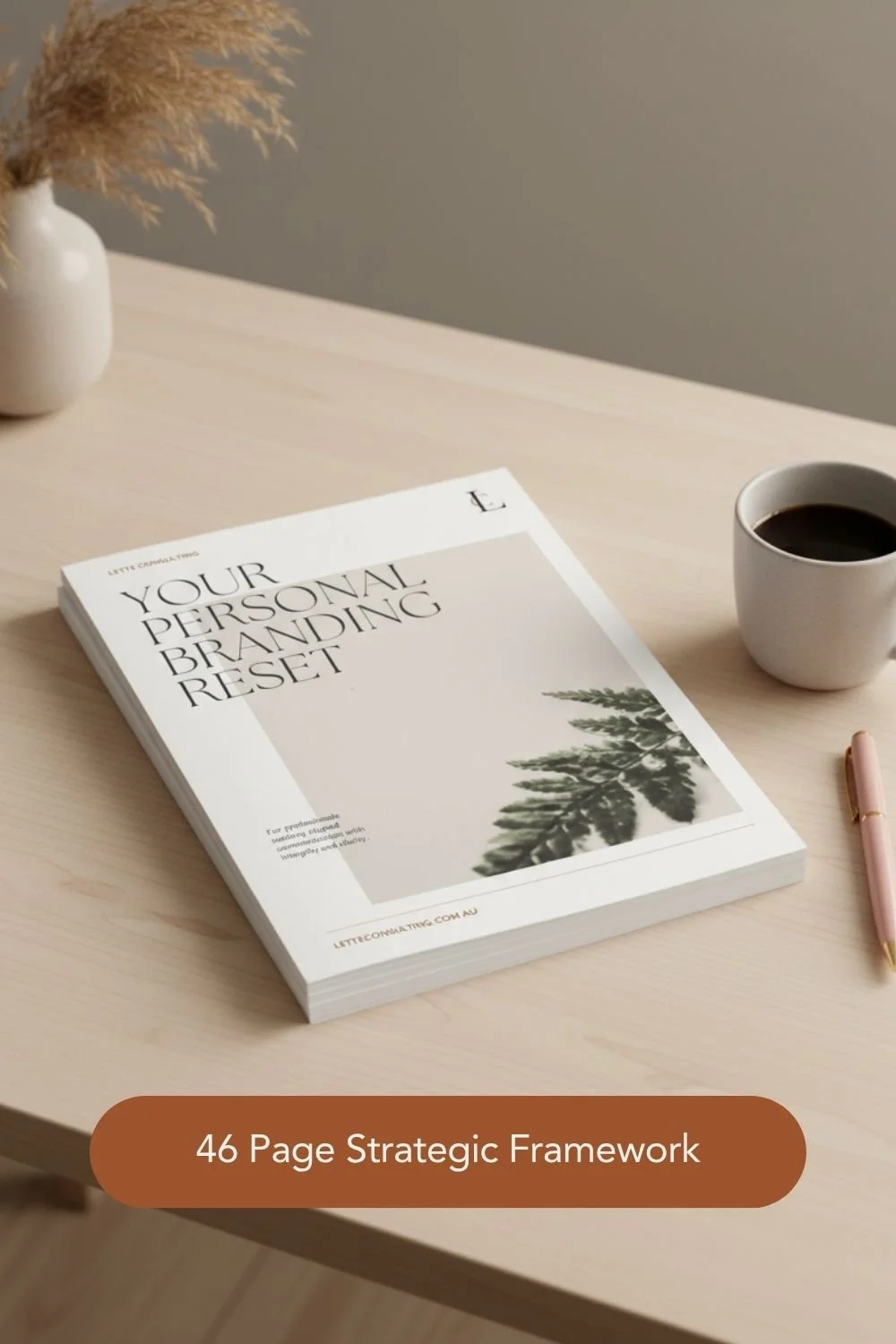
The Personal Branding Reset was designed for exactly this moment.
It provides a structured way to step back from the noise of constant visibility and think more carefully about:
how your expertise has evolved
how you want to be understood
how your professional story is communicated
Not as a quick fix.
But as a deliberate process of alignment.
Because when your positioning is clear, communication becomes far easier.
And your LinkedIn profile starts to feel like it fits again.
Because your competence deserves language that reflects it.
Your career evolved.
Your language didn’t.
If your LinkedIn and professional narrative no longer reflect the level you’re operating at, you’re likely being overlooked for the opportunities you’re ready for.
At a certain point in your career, something subtle shifts.
The work you do becomes more strategic.
Your thinking deepens.
The direction you want to move in becomes clearer.
But the way you describe your work doesn’t keep pace.
Your LinkedIn feels slightly off.
You hesitate when updating your profile.
Posting feels uncomfortable — even though you have something to say.
Not because you lack expertise.
Because your positioning hasn’t caught up yet.
This is the gap most professionals don’t know how to close.
Is this you?
Uncertain strategy: You know personal branding matters, but it keeps falling to the bottom of the list
External visibility: You’re respected internally but barely visible externally
Digital presence: You’ve rewritten your LinkedIn profile countless times, or you ignore it completely
Content strategy: You default to resharing company content because you don’t know what to post
Competitive landscape: You see people with less experience building visibility faster than you
Standing out: You’re in the job market but you’re not landing interviews for jobs that you know you’re qualified for
The Personal Branding Reset is a 46-page strategic framework designed to help you:
Reposition your expertise
Articulate your value clearly
Align your communication with where your career is going
Inside Your Personal Branding Reset:
Identity audit → clarify how you’re currently perceived
Articulation frameworks → translate expertise into positioning
Practical prompts → so you’re never staring at a blank page again
Your competence deserves better language.

For many professionals, LinkedIn starts as a digital version of their resume. Early in a career, that makes sense. But careers evolve.