
One of the most common challenges experienced professionals face is not a lack of expertise.
It’s a lack of language.
Over time, careers evolve. Roles expand. Responsibilities deepen. The way you deliver value becomes more nuanced and strategic.
But the words used to describe that work often remain unchanged.
This creates what I think of as the language gap — the moment when your career evolves faster than the words you use to describe it.
The Articulation Gap
When working with senior professionals, one pattern appears consistently.
People tend to describe:
what they do
how they do it
But rarely the value or outcomes their work creates.
Titles alone cannot carry the weight of that story.
In complex professional roles — particularly in fields like law, consulting, and advisory work — the number of responsibilities you carry can make defining yourself online feel overwhelming.
But that complexity is not a burden.
It is an opportunity.
Instead of describing actions, consider describing your approach.
How do you think about problems?
How do you guide clients through complexity?
What distinguishes your perspective?
Often, those answers reflect you far more accurately than a list of responsibilities.
Identity vs Expertise
When professionals begin describing how they approach their work, something interesting happens.
The conversation shifts.
The focus moves from technical expertise to professional identity.
Expertise remains important, but it becomes assumed rather than explained.
And when expertise is assumed, trust builds more naturally.
The conversation becomes less about proving competence and more about demonstrating perspective.
That shift is powerful — because perspective is what differentiates you.
Language as Strategy
For professionals whose work centres on expertise, thinking, and advice, language is not just a communication tool.
It is part of the product.
The way you articulate your ideas shapes how others understand the value of your work.
Which is why cutting and pasting the language of others — especially when time is tight — can quietly weaken your professional reputation.
Every post, article, or comment online should feel like a conversation with you.
Not a borrowed voice.
One of the simplest ways to test this is to read your writing aloud.
Or speak the words to a trusted colleague as if you were explaining the idea over coffee.
If the language feels natural in conversation, it will resonate online.
Because ultimately, your competence deserves language that reflects it.
Your career evolved.
Your language didn’t.
If your LinkedIn and professional narrative no longer reflect the level you’re operating at, you’re likely being overlooked for the opportunities you’re ready for.
At a certain point in your career, something subtle shifts.
The work you do becomes more strategic.
Your thinking deepens.
The direction you want to move in becomes clearer.
But the way you describe your work doesn’t keep pace.
Your LinkedIn feels slightly off.
You hesitate when updating your profile.
Posting feels uncomfortable — even though you have something to say.
Not because you lack expertise.
Because your positioning hasn’t caught up yet.
This is the gap most professionals don’t know how to close.
Is this you?
Uncertain strategy: You know personal branding matters, but it keeps falling to the bottom of the list
External visibility: You’re respected internally but barely visible externally
Digital presence: You’ve rewritten your LinkedIn profile countless times, or you ignore it completely
Content strategy: You default to resharing company content because you don’t know what to post
Competitive landscape: You see people with less experience building visibility faster than you
Standing out: You’re in the job market but you’re not landing interviews for jobs that you know you’re qualified for
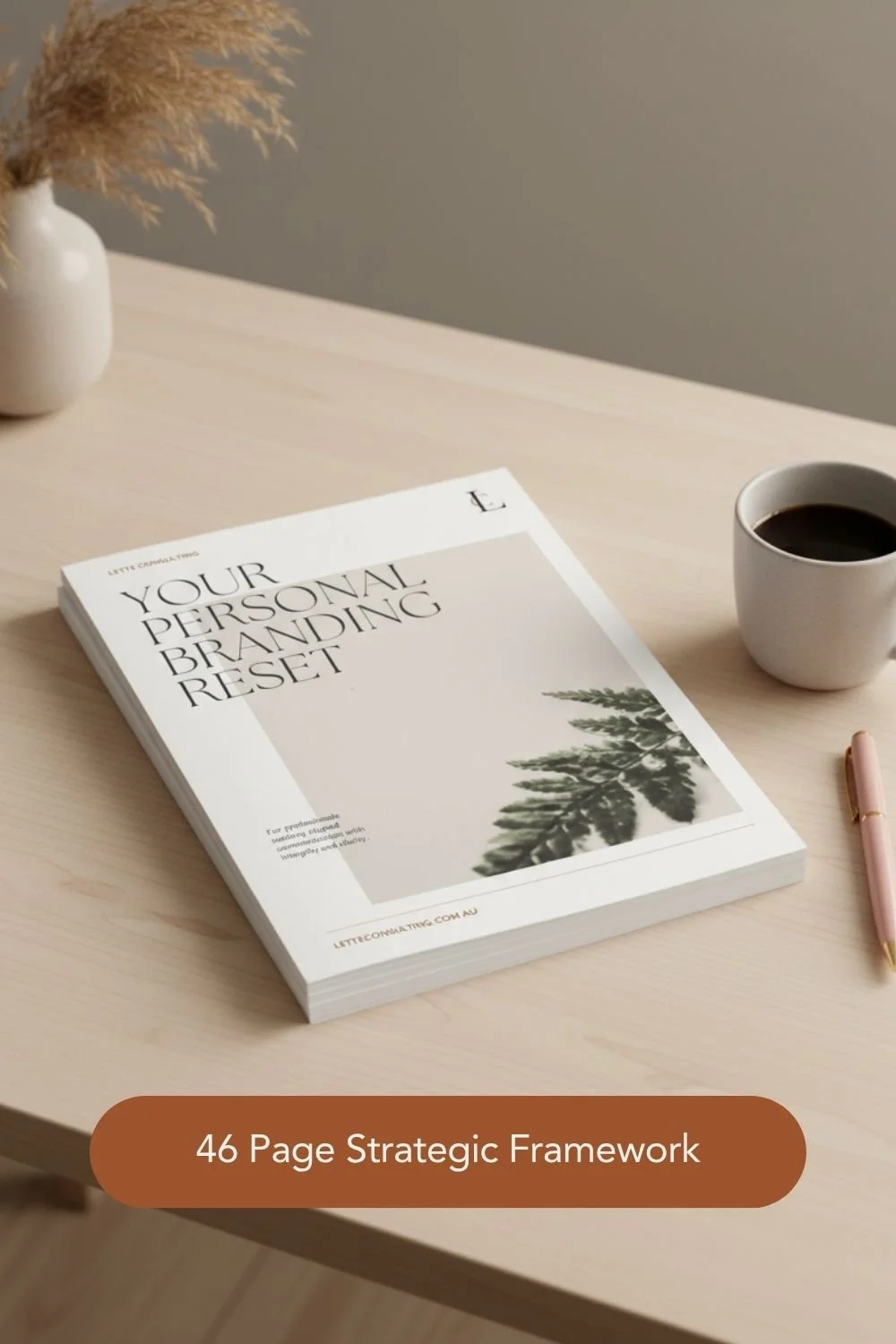
The Personal Branding Reset is a 46-page strategic framework designed to help you:
Reposition your expertise
Articulate your value clearly
Align your communication with where your career is going
Inside Your Personal Branding Reset:
Identity audit → clarify how you’re currently perceived
Articulation frameworks → translate expertise into positioning
Practical prompts → so you’re never staring at a blank page again
Your competence deserves better language.

For many professionals, LinkedIn starts as a digital version of their resume. Early in a career, that makes sense. But careers evolve.